


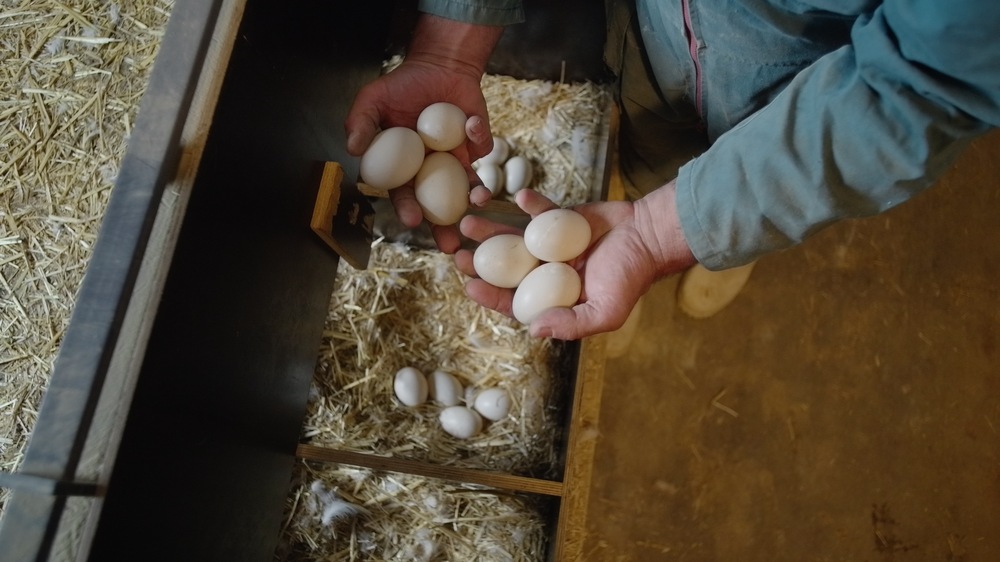
Every step counts when it comes to producing ducklings, and egg collection is no exception. Much more than a simple collection, this is a crucial stage which has a direct influence on the quality of the eggs, their incubation and the quality of the ducklings marketed.
Adopting good technical practices not only preserves the integrity of the shell, but also guarantees the freshness and safety of the final product.
To obtain a viable duckling, the egg must meet several criteria, both physical and sanitary. Firstly, the egg must come from a healthy duck that has been vaccinated to pass on antibodies to the ducklings (the vaccine prophylaxis must be adapted to local pathologies).
This article will begin by describing the qualities of the eggs so that the reader is aware of the actions taken during collection. Secondly, the collection and storage of eggs on farms will be discussed.
1 – What defines eggshell quality?
In Pekin ducks, the physical quality of eggs for incubation is essential to ensure a good hatching rate and good duckling viability. Here are the main criteria to consider when sorting eggs as soon as they are collected from the farm.
Physical quality of the egg
The egg must be of uniform shape and size, with a minimum weight.
- The egg must be oval, with no excess roundness or too pronounced point.
- Regular size (average weight between 80 and 94 g, depending on the line) ensures balanced embryonic development. The weight of the duckling is directly linked to the weight of the egg.
- As egg weight changes over the course of the laying period, it is important to monitor the average weight of the eggs on a weekly basis. If there is any loss of egg weight, this indicates either technical problems in the management of the batch, or unsuitable feed, or a pathological issue. Weighing the eggs also makes it possible to adapt the feed formula to the ducks’ nutritional requirements. The older the duck, the heavier the eggs. Once past a certain stage, large eggs have fragile shells and become more difficult to incubate. In this case, generally provides a feed that limits egg weight gain and corresponds to the calcium requirements of the moment.
The shell
The shell must be healthy, solid and of good quality
- It must be thick enough (around 0.3 to 0.4 mm) to avoid excessive moisture loss or microbial contamination.
- Its surface must be smooth and clean, with no cracks or roughness.
- Porosity must be controlled: too many pores encourage water loss, too few hinder gas exchange.
- The quality of the shell depends on the rearing phase; during this period, it is important to provide the nutrients required for the proper development of the medullary bone. The medullary bone is the organ that stores and releases calcium for each egg laid.
Internal composition of the egg
- The yolk must be intact (centred, not mobile). There should be no blood spots, double yolks or lines of calcification.
- The inner tube must be well formed and stable, and the chalazas solid.

2 – Collecting the eggs: a key link
Preparing nests and environmental conditions
To preserve the qualities of the egg mentioned above, it is important to take the greatest care with the nest and egg collection.
- When the eggs are laid, they must be laid in clean, dry nest litter that is free from faecal matter and mould.
- The nests are regularly mulched and maintained.
- The environment in the rearing building must be controlled according to the following criteria. Temperature, ventilation and humidity are controlled to limit microbial contamination in the nests.
Good collection practices
- Eggs can be collected 3 to 5 times a day to avoid stagnation in warm, damp areas.
- Always handle eggs with clean hands or gloves.
- Excessive shaking, jolting or rolling should be avoided as this could damage the internal membranes, displace the yolk and/or break the chalazas.
- Any egg that is too dirty or broken, has a double yolk or is too small should be removed from the incubation batch.
- The shells must be free of faecal contamination, feathers or organic debris.
- It is important to avoid washing with water: if they are dirty, use a dry cleaning system.
- To avoid destabilising the germ cell, never turn the egg on itself when cleaning it.
The eggs are identified according to the laying date and the reference of the breeding flock.

3 – Egg storage
Ideal storage conditions for rearing eggs should be in an air-conditioned room to ensure a regular temperature and hygrometry whatever the season (temperature between 12-16°C, relative humidity around 75%). These conditions guarantee an optimum start to incubation.
The eggs are stored on trays or grids with the points down (air chamber up).
Thermal and mechanical shocks should be avoided as far as possible.
The ideal storage period is less than 7 days, after which embryonic viability declines.
In short, successful hatching in Pekin ducks depends on rigorous control of all the parameters associated with the egg, from its formation to storage. Each link in this chain has a direct influence on the development potential of the future duckling. Meticulous attention to every stage of the process means that not only can we optimise hatching rates, but we can also guarantee the health and vigour of the young animals.

